Hill People Gear Tarahumara vs. Osprey Flapjill
Two carry-on travel backpacks, compared spec for spec.
Hill People Gear Tarahumara

| Capacity | 16 L |
| Weight | 0.7 kg |
| Dimensions | 43×23×10 cm |
| Airline fit | 96% |
| Price | $175 |
Feature by feature
| Hill People Gear Tarahumara | Feature | Osprey Flapjill |
|---|---|---|
| Storage | ||
| 2 | Compression | |
| None | Expanded Capacity | None |
| 0 | Opening | 0 |
| back | Passport | side |
| N | Passthrough | N |
| Carry | ||
| Y | Backpack | |
| removable | Hip Belt | removable |
| Y | Sternum Strap | |
| Inside | ||
| N | Laptop | 15in |
| 2 | Main Compartments | 3 |
| N | Organizer | Y |
| Outside | ||
| × | Hard Shell | × |
| N | Rain-fly | N |
| 2, side | Water Bottle Holder | |
| Y | Water Resistant | Y |
| Material | |
| 500d Cordura | 600D Polyspun |
Osprey Flapjill
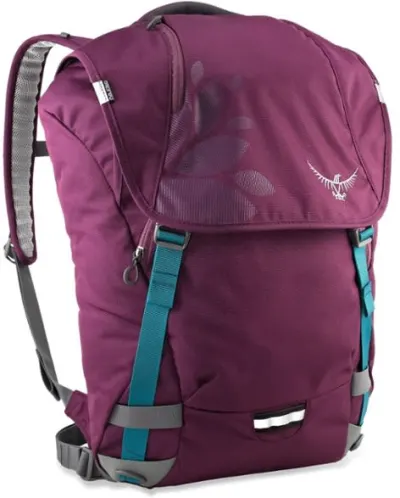
| Capacity | 19 L |
| Weight | 0.9 kg |
| Dimensions | 46×34×23 cm |
| Airline fit | 74% |
| Price | $110 |
Key differences between the Hill People Gear Tarahumara and Osprey Flapjill
- Passport pocket: Back on the Hill People Gear Tarahumara; Side on the Osprey Flapjill.
- Laptop sleeve: No on the Hill People Gear Tarahumara; 15in on the Osprey Flapjill.
- Main compartments: 2 on the Hill People Gear Tarahumara; 3 on the Osprey Flapjill.
- Built-in organizer: No on the Hill People Gear Tarahumara; Yes on the Osprey Flapjill.
Both have: hip belt, water resistant.
Which airlines take each bag as a carry-on
We checked both bags against the carry-on size limits of 189 airlines. 139 accept both. 42 accept only the Hill People Gear Tarahumara, and 0 accept only the Osprey Flapjill.
Only the Hill People Gear Tarahumara fits
Air Baltic, Air China, Air Malta, Air Niugini, Air Serbia, Air Seychelles, Air Tahiti, American Eagle, Asiana Airlines, ATA Airlines, Belavia, Blue Air, Bulgaria Air, China Eastern, easyJet, Emirates Airlines, Enter Air, flybe, Great Lakes Airlines, Gulf Air, Icelandair, InselAir, Juneyao Airlines, Liat Airlines, Luxair, Meridiana Fly, Nordwind Airlines, Pakistan International, Royal Brunei Airlines, Ryanair, S7, Shandong Airlines, Shenzhen Airlines, Sun Express, TAP Air Portugal, TAROM, Tianjin Airlines (A320 & E190), TUI, Ukraine International, VIM Airlines (Closed), Volotea, Xiamen.
The Hill People Gear Tarahumara and the Osprey Flapjill may appear similar in their fundamental purpose as carry-on backpacks, but delve a little deeper and you'll find each possesses distinctive qualities that set them apart. Allow me to begin with the Hill People Gear Tarahumara. At a mere 0.7 pounds, it is significantly lighter than the Flapjill, making it effortlessly convenient for on-the-go travels. Spanning the dimensions of 44 inches in height, 24 inches in width, and 10 inches in depth, it provides ample storage with a capacity of 16 liters. Designed with 500D Cordura, its sturdiness is commendable. However, it lacks a laptop compartment, with a focus more on essentials for day hiking.
In comparison, the Osprey Flapjill strikes a balance between portability and storage space. Marginally heavier at 0.9 pounds, it compensates with an enhanced width of 34 inches and depth of 23 inches, thus boasting a larger capacity of 19 liters. A welcoming feature is its dedicated laptop compartment, able to accommodate a 15-inch device, making it favorable for digital nomads. Crafted from 600D Polyspun, it also guarantees longevity of usage.
In summary, here's a crisp comparison between the two:
- Dimensions: Tarahumara is 44x24x10 inches while the Flapjill is a larger 46x34x23 inches
- Weight: Tarahumara is lighter at 0.7 pounds, compared to Flapjill's 0.9 pounds
- Capacity: Tarahumara offers a 16 liter capacity, while the Flapjill provides a higher 19 liter capacity
- Material: Tarahumara is made of 500D Cordura while the Flapjill is made of 600D Polyspun
- Laptop Compartment: Tarahumara lacks a laptop compartment, while the Flapjill can house a 15-inch laptop
Reviewer sentiment about both backpacks echoes the sentiments noted above. Tarahumara admirers value its simplicity, diminutive exterior appearance, space-efficiency, and the convenience of its center zip for easy access to the main compartment. Conversely, praise for the Flapjill centers around its higher storage capacity and laptop-friendly provisions. Both are considered staunchly built, reliable, and ideally suitable for their respective functions. While Tarahumara bags the title of 'best overall solution to the one-daypack question', Flapjill robustly caters to the urban travelers' needs. It all boils down to your personal preference and specific requirements; the decision laying solely in your hands to opt for one over the other.