Osprey Porter 46 vs. Kathmandu Litehaul 38L Carry-On Pack
Two carry-on travel backpacks, compared spec for spec.
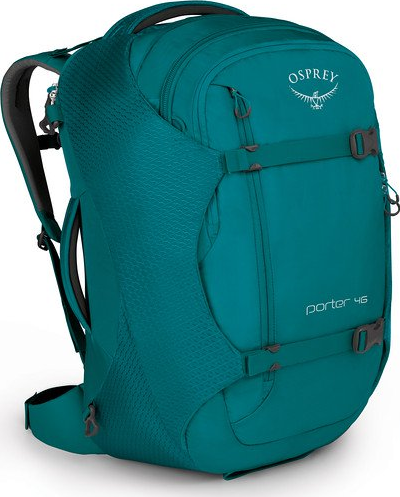
Feature by feature
| Osprey Porter 46 | Feature | Kathmandu Litehaul 38L Carry-On Pack |
|---|---|---|
| Storage | ||
| 2 | Compression | Y |
| None | Expanded Capacity | None |
| 1 | Opening | 4 |
| top | Passport | N |
| Y | Passthrough | N |
| Carry | ||
| hideable | Backpack | Y |
| hideable | Hip Belt | hideable |
| Y | Sternum Strap | hideable |
| Inside | ||
| 16in | Laptop | 17in |
| 4 | Main Compartments | 2 |
| Y | Organizer | N |
| Outside | ||
| × | Hard Shell | × |
| N | Rain-fly | N |
| N | Water Bottle Holder | 1 |
| Y | Water Resistant | Y |
| Material | |
| bluesign®-approved Recycled 500D Nylon Packcloth PFC Free DWR | Recycled Polyester/Nylon |
Kathmandu Litehaul 38L Carry-On Pack

| Capacity | 38 L |
| Weight | 1.31 kg |
| Dimensions | 55.88×32×28.45 cm |
| Airline fit | 2% |
| Price | $150 |
Key differences between the Osprey Porter 46 and Kathmandu Litehaul 38L Carry-On Pack
- Compression straps: 2 on the Osprey Porter 46; Yes on the Kathmandu Litehaul 38L Carry-On Pack.
- Opening: Clamshell on the Osprey Porter 46; Top zip on the Kathmandu Litehaul 38L Carry-On Pack.
- Passport pocket: Top on the Osprey Porter 46; No on the Kathmandu Litehaul 38L Carry-On Pack.
- Luggage passthrough: Yes on the Osprey Porter 46; No on the Kathmandu Litehaul 38L Carry-On Pack.
- Backpack straps: Hideable on the Osprey Porter 46; Yes on the Kathmandu Litehaul 38L Carry-On Pack.
- Sternum strap: Yes on the Osprey Porter 46; Hideable on the Kathmandu Litehaul 38L Carry-On Pack.
- Laptop sleeve: 16in on the Osprey Porter 46; 17in on the Kathmandu Litehaul 38L Carry-On Pack.
- Main compartments: 4 on the Osprey Porter 46; 2 on the Kathmandu Litehaul 38L Carry-On Pack.
- Built-in organizer: Yes on the Osprey Porter 46; No on the Kathmandu Litehaul 38L Carry-On Pack.
- Water bottle pockets: No on the Osprey Porter 46; 1 on the Kathmandu Litehaul 38L Carry-On Pack.
Both have: hip belt, water resistant.
Which airlines take each bag as a carry-on
We checked both bags against the carry-on size limits of 189 airlines. 4 accept both. 112 accept only the Osprey Porter 46, and 0 accept only the Kathmandu Litehaul 38L Carry-On Pack.
Only the Osprey Porter 46 fits
Aegean Airlines, Aer Lingus, Aeroflot, Aeromexico, Air Asia, Air Astana, Air Canada, Air Caraibes, Air Europa, Air Koryo, Air Macau, Air Nostrum, Air Tahiti Nui, Air Wisconsin, AirAsiaX, Alaska Airlines, All Nipon Airways, Allegiant Air, American Airlines, ANA, Atlas Global, Austrian, Avianca , Azerbaijan Airlines, Azul Linhas, Bahamasair, Bangkok Airways, Biman Bangladesh, British Airways, Brussels Airlines, Cambodia Angkor Air, Caribbean Airlines, Cathay Pacific, Cebu Pacific, China Airlines, China Southern, CommutAir, Conviasa, Copa Airlines, Cubana de Aviacion, Czech Airlines, Delta Airlines, Dragonair, EL AL, Ethiopian Airlines, Eurowings, EVA Air, Fiji Airways, Finnair, Flair Air, Frontier Airlines, Garuda Indonesia, Gol Linhas Aereas, Hainan Airlines, Hawaiian Airlines, Hong Kong Airlines, Iberia, Interjet, Iran Air, Iran Aseman Air, Island Air, Japan Airlines, Jet2, jetBlue Airways, Jetstar Airways, Jetstar Asia, Korean Air, Kulula, Kuwait Air, LOT Polish, Lufthansa, Mahan Air, Malaysia Airlines, Mango, Mesa Airlines, Middle East Airlines, Monarch Airlines, Norwegian, Onur Air, Peach, PenAir, Philippine Airlines, Porter Airlines, Qantas Airways, Republic Airways, Royal Air Morocco, SAS Scandinavian, Saudi Arabian Airlines, Sichuan Airlines, SilkAir, Silver Airways, Singapore Airlines, Skywest, Inc., South African Airways, Southwest Airlines, SpiceJet, Spirit Airlines, SriLankan Airlines, Sun Country, Swiss Int'l Air Lines, TAAG Angola, TAM Airlines, Thai Airways, Trans States, Travel Service Airlines, Turkish Airlines, United Airlines, Ural Airlines, Uzbekistan Air, Vietnam Airlines, Virgin Atlantic, WOW Airlines.
The Osprey Porter 46 and the Kathmandu Litehaul 38L Carry-On Pack are both high quality travel backpack options, attracting the attention from globetrotters worldwide. With their distinct designs and unique qualities, both backpacks leave a lasting impression on their users. Standing 23 inches tall, 36 inches wide, and 56 inches deep, the Osprey Porter 46 is a spacious bag designed for those traveling with a good amount of gear. It confidently packs 46 liters of capacity and weighs only 1.5 pounds. Made of durable nylon, this backpack features a laptop compartment that conveniently houses a 1 inch laptop. Compatible with 47% of airlines, the Porter 46 is a versatile choice for many travellers.
Meanwhile, the Kathmandu Litehaul 38L Carry-On Pack is a more streamlined choice, being 28.45 inches tall, 32 inches wide, and 55.88 inches deep. This eco-conscious backpack is made of Recycled Polyester/Nylon and weighs slightly less than its competitor at 1.31 pounds. Although smaller in capacity, at 38 liters, it still features a laptop compartment that comfortably fits a 17 inch laptop. However, this backpack only fits within the carry-on regulations of 19% of airlines.
To summarize, here are the differences between the two:
- Dimensions: Osprey Porter 46 is larger than the Kathmandu Litehaul 38L Carry-On Pack.
- Material: Osprey Porter 46 is made of Nylon while Kathmandu Litehaul is made of Recycled Polyester/Nylon.
- Weight: Osprey Porter 46 is slightly heavier than the Kathmandu Litehaul.
- Capacity: Osprey Porter 46 offers more storage space with 46 liters whereas Kathmandu Litehaul offers 38 liters only.
- Laptop Compartment: Osprey Porter’s laptop compartment fits a 1 inch computer, while Kathmandu Litehaul’s fits a 17 inch computer.
- Airline Compatibility: Osprey Porter is compatible with more airlines than Kathmandu Litehaul.
Reviewers have lauded the Osprey Porter 46 for its spaciousness, sturdy construction, comfortable suspension and its clamshell opening for quick packing. In contrast, the Kathmandu Litehaul received praise for its eco-friendly materials, stowaway straps, suitcase-like opening, and comfortable Air Pod System. Both backpacks, in their distinct ways, offer value in their price ranges and are designed with thoughtful features to meet the varying needs of travellers. Deciding between the two ultimately comes down to personal preferences in terms of size, weight, material choice, and airline compatibility.